
If your Shopee account got suspended tomorrow, would your business survive?
Imagine opening Seller Centre tomorrow and finding your shop frozen. Listings hidden, orders stopped, and an appeal that could take weeks. For many Malaysian sellers, that one screen is the whole business. Here’s how to check your risk, and build a backup before you need it.
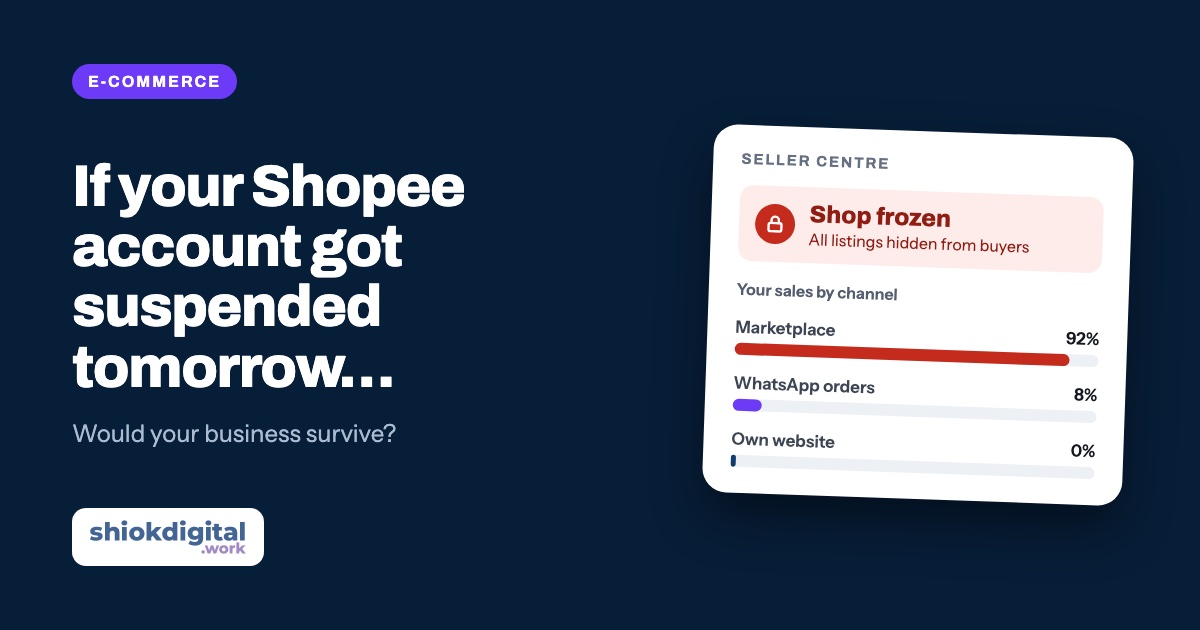
If most of your sales come from one marketplace, your business depends on rules you don’t control. Penalty points from late shipments, cancellations or listing violations can lead to lost privileges, lower visibility or a frozen account. Keep your account healthy, but also build channels you own: your own customer list, a website and direct WhatsApp orders.
How it happens (often faster than you think)
Shopee, like other marketplaces, runs a penalty point system. According to Singapore’s Ministry of Home Affairs, which rates marketplace safety, building up penalty points can lead to sellers losing privileges, such as exclusion from marketing campaigns or listings being pushed down in search, or even account suspension. Sellers commonly get points for:
- Late shipments during a busy sale period or when a courier lets you down;
- Cancelled or unfulfilled orders when stock runs out;
- Listings that break the rules, such as prohibited items, misleading photos or keyword spam;
- Counterfeit or IP complaints, sometimes from a competitor.
Even without a penalty, the ground can shift under you: commission rises, a new fee, an algorithm change that buries your listings, or a competitor selling the same item for RM2 less. We broke down the fees in how much Shopee and TikTok Shop take from every sale.
The 10-minute risk check
Get a piece of paper and answer honestly:
- What percentage of last month’s sales came from one platform? Above 80% means one decision outside your control could stop most of your income.
- How many of your customers can you contact directly, with their permission, without going through the platform?
- If customers search for your brand on Google, do they find your own page, or only your marketplace listing?
- How long could you pay your costs (stock, rent, staff) with zero platform sales?
If those answers make you uncomfortable, you’re not alone. Most small sellers grow on one platform first. The point is to start building a second leg before you need it.
A 5-step backup plan
1. Keep your marketplace account healthy
Prevention is cheapest. Check your shop performance and penalty points every week, ship on time, keep stock counts accurate, and read the policy updates in your Seller Centre. Rules and thresholds change several times a year.
2. Build your own customer list, the right way
Don’t pull marketplace buyers off the platform; that breaks the rules and can earn penalties. Instead, collect contacts from your own channels: Instagram, TikTok, Facebook, walk-in customers and people who WhatsApp you directly. Ask for permission to send updates and follow Malaysia’s PDPA.
3. Have a website that’s yours
Your own website is the address no platform can take away. Put it in your social bios, on your business cards and in your ads. Customers who search for your brand on Google land on your page, with your prices and your WhatsApp.
4. Take direct orders on WhatsApp first
You don’t need a full online store on day one. A simple product catalogue with a WhatsApp order button is enough to start getting direct orders without commission. When direct orders grow, add a cart and payment gateway.
5. Spread your sales channels
Two marketplaces plus your own website plus social media is much safer than one marketplace alone. If one channel has a bad month, or freezes, the others keep you going.
Where to start this week
- Check your penalty points and fix anything close to a limit.
- Work out your platform share of last month’s sales.
- Add a WhatsApp link to every social media bio.
- Plan your own website: even a simple catalogue page is a start.
Build the part of your business no platform can switch off
Shiok Digital e-commerce websites start from RM2,500, one fixed price: your own online store with your products, your prices and your customers. WhatsApp us what you sell and where you sell it now.
Frequently asked questions
Why do Shopee seller accounts get frozen or suspended?
Usually because of penalty points from late shipments, cancelled or unfulfilled orders, prohibited or counterfeit items, or listings that break the rules. When enough points build up, Shopee can remove privileges such as campaigns, lower your listings in search, stop you creating or editing listings, or freeze the account. Check the current rules in your Seller Centre, as thresholds change.
Can I tell my Shopee buyers to order from my website instead?
Be careful. Marketplaces generally prohibit sellers from directing buyers off the platform through chat, listings or parcels, and doing so can earn penalties. Build your own customer base through your own channels: social media, Google, ads and customers who contact you directly.
Do I need a full online store to have a backup?
No. Many sellers start with a simple website that shows their products and takes orders on WhatsApp, then move to a full online store with cart and payment gateway when direct orders grow.
How much does my own online store cost?
At Shiok Digital, e-commerce websites start from RM2,500 with one fixed price agreed before work starts. Ongoing costs are usually hosting, the domain and payment gateway fees.